


VISUAL ART
Rawz creates in several visual mediums, see below for a selection of his work.
WE ARE
The first visually focused Digging Crates project, WE ARE is a response by Rawz to Chardin & Boy - a portrait of an unnamed crying child of African decent, and 17th century royal court jeweller Jean-Baptiste Chardin.
Commissioned by the History of Science Museum following the removal of the portrait from display - a process Rawz was central in instigating, WE ARE transforms the frame that once held an image of oppression into a celebration of collective identity.

He ran two digital art workshops at the museum with a local Sudanese Arabic Saturday School. Young people photographed objects from the collection, and created digital responses with help from Rawz. Their smiling faces became part of a new image inside the frame, alongside images of Black scientists from Oxford University. The children's names, drawings and words were digitally placed onto the frame itself graffiti style, giving the young artists ownership of the frame.
At the centre of the piece, Boy has been freed from his original context. The collar and tear are gone. He now holds a scroll bearing a poem Rawz wrote for the piece - not another man's map, but his own proclamation.
An audio recording of Rawz performing the poem is played at regular intervals alongside the visual work in the museum's main gallery.
Listen to the recording here.

While researching his response, Rawz discovered that the reason the portrait had remained on display in the museum for almost 70 years was because the frame around it connected with navigational instruments also held in the museum's collection - he resolved to keep the frame on display, but change the image it contained.

We Are is on permanent display in the Top Gallery of the History of Science Museum, Oxford.
Visit the museum's page.

Rawz talking at the WE ARE celebration and launch event.
image: Fyrefly Studios
ARTIST'S STATEMENT
The following statement by Rawz sits beside WE ARE in the museum's main gallery:
"With this piece I wanted to address an erasure that was embodied by the presence of the Chardin & Boy portrait.
The unnamed child in the Chardin portrait was never given a name, just as the contributions of African and African diasporic people to the History of Science were not named in this museum.Names give humanity and acknowledgement, they encourage empathy.The old portrait was not interested in that. The painting that hung in this museum for nearly seventy years was here because of the navigational instruments depicted on the frame. The suffering depicted in Boy's image was less significant than the gold surrounding it.I kept the frame deliberately. The frames placed around us by others decide our narratives if we accept them. I wanted to show that the frame can be changed - that we can navigate our way out of it.
Boy now holds a proclamation of unity instead of borders drawn on another man's map.
We Are.
All of us.
Many things.
Many possibilities.
We Are all of it.
The frame is now filled, not with tears, restraints and oppression, but with smiles, freedom and expression that spills outside of its boundaries. Boy is a fictive character that once represented the realities of millions of human beings. Through We Are, his story is now about claiming a future filled with joy and companionship.
A future that extends beyond the edges of someone else's frame."
Visual Research:
Rethinking Relationships


Rawz was asked to spend some time conducting research with objects from Kenya, Tanzania and Uganda held at the Pitt Rivers Museum as part of the Rethinking Relationships project; a sector leading collaboration between the Museum Ethnographers Group and four museums with world cultures collections (the Pitt Rivers Museum - Oxford, the Horniman Museum - London, the World Museum - Liverpool, and the Museum of Archaeology and Anthropology - Cambridge).
To do this, Rawz developed a unique art based, curiosity led methodology, centred on spending two consecutive days in the same physical space as a selection of objects, and responding to any questions and feelings that arose from this experience by creating visual art. He consulted museum archives and staff for further information to inform the creative process.
What follows is the content of his research report.


With the help of project staff, I identified a selection of ten objects from the Pitt Rivers’ vast digital catalogue. This was a difficult and time consuming task - the amount of material was quite overwhelming, and not all catalogue entries held pictures of the objects. I often relied on text descriptions and imagined what objects might look like. I selected objects based on instinctive curiosity, trying not to think too much about why I wanted to spend time with an object. The only constraint I gave myself was that I wanted to bring together a group of objects created over a wide timeframe - I tried not to select too many objects from the same decade.
There were some complications regarding availability, but we managed to curate a satisfactory host of objects and on the morning of November 25th 2025, I felt excited as we laid them out on the table for my first day of research.
I began my process by holding each object and looking at it closely, imagining what the person who created it might have been feeling while making it, what techniques and tools they might have used, how long it must have taken, how hard they had to concentrate. After a short time I began photographing the objects as a different means of looking. This mode allowed me to view things more closely and preserved the way I saw those objects on that day, providing material for future interpretation. It also enabled me to see from angles not otherwise possible. I found it interesting to photograph the objects through a magnifying glass provided by a member of the project team.

Photographing this beer gourd through a magnifying glass gave me insight into how someone who had just consumed the vessel’s contents might have looked at it.

I was able to photograph the inside of this medicine bag from an angle I couldn’t see otherwise. One of my most vivid memories from the days I spent with these objects was the overpowering smell of tobacco coming from this bag, possibly from time it spent stored in the office of a pipe smoker.

Using my phone’s camera enabled me to play with scale - helping me to imagine this lion as a life sized sculpture.

After photographing the objects, I opened the bag of art supplies I had brought with me and began drawing. I didn’t plan what I would do, or have any preconceived concept. I wanted what I produced to be a record of my thoughts and feelings while sharing space and time with these objects. I let my instinct decide which objects I focused on and how, I ended up spending most of the first day exploring and reinterpreting the patterns on the Ugandan beer gourd, and much of the second day with a Tanzanian carved figure of a woman.
On the second day I found myself curious of what the woman may be carrying on her back. With no information forthcoming from the museum archive, I asked a friend from Tanzania who, after consulting her father, informed me that it was likely migomba which are plantains, or possibly firewood. It would be hard to say for certain without knowing which region of Tanzania the carving was from.
This image is the work I started on those first two days - it remains unfinished.
I spent some time after those two research days contemplating what to do next.
I considered spending some more time working on the piece started in the research office, but felt that energy had dissipated.
I decided to use the pictures I’d taken during my research days in the museum to create a digital collage. This turned into a collection of six new works.
Three of the pieces are aesthetic works inspired by the shapes textures and patterns I encountered during my research.
Three of the pieces use metaphor and symbolism to transmit my feelings regarding the objects, their connected histories, and their presence in Oxford.
BAR CLOTH
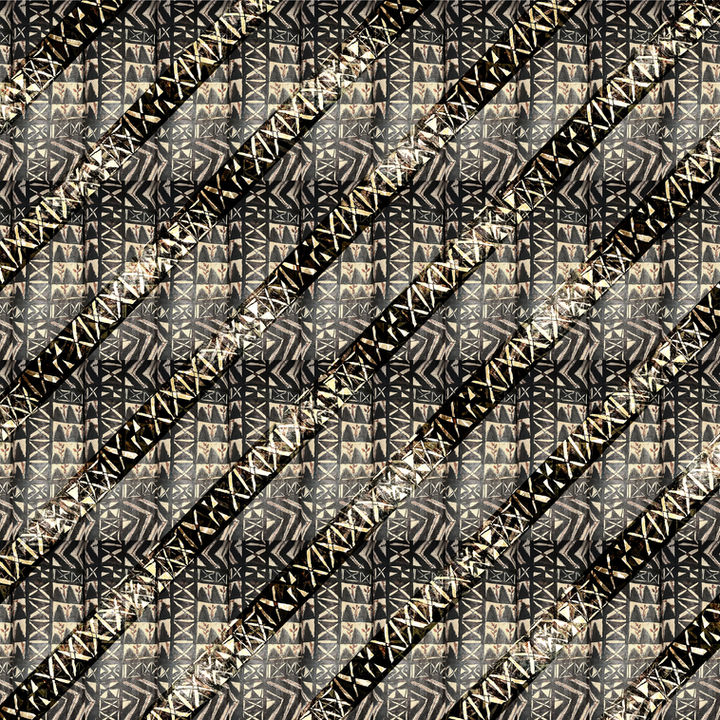
When I arrived for my first research day I learned that museum staff had spent much of the morning trying to remove the bark cloth I had requested from display. It had been placed in a case alongside other examples of bark cloth from around the world and they had not been able to move it as the bark cloths had effectively been built into the case. The project worker pointed out the requested item through the glass of the case and I took this picture.

I was reminded of the track Glass Cages, made during the first iteration of my Digging Crates project which took place in the museum.
I used an image of the bark cloth I thought I recalled my museum friend directing me towards to create the digital collage on the previous page, picking out a rectangular motif and repeating it to symbolise prison bars, perhaps imprisoning the bark cloth, perhaps locking the viewer behind bars.
Since creating the piece I have realised that the item I requested was in fact the bark cloth displayed below the one I used to create the collage, adding a not displeasing layer of irony to the concept of my piece.
WAVED

I felt very drawn to the pattern on the Ugandan beer gourd from the first time I saw it on my first research day on this project, and it has stayed with me throughout this process. I picked out a curved motif that I felt had similarities with several works I had created before encountering this object.

Using digital software, I repeated and interlocked this motif in a way I found pleasing, and was happy to find that the repeated pattern combined with the lighting in my photograph produced an effect similar to the waves of sand dunes in a desert, water in an ocean, or hair in a popular African/ diasporic hairstyle.
I used filters and blending methods to accentuate this effect before laying a slightly distorted black and white photograph of the beer gourd viewed through a magnifying glass underneath. I enjoyed how the circle of the magnifying glass mirrored the circular shapes created by the beer gourd pattern.

PROTECTION

I was unable to access the amulet for protection against evil I had requested, so identified this silver amulet by means of replacement.
I couldn't find a translation or translator to help me understand the inscription on the front of the amulet, but found its shape reminiscent of ramparts or a similar defensive structure. Other clues suggested it may have been made as some kind of protection or good luck device.
I liked the smooth surface on the back of the amulet, and found it interesting that it was broken only by the ascension number assigned by the museum. I layered multiple copies of the amulet on top of each other, using different blending techniques to create an image reminiscent of a target, or a fortification viewed from above.


APPROPRIATION

THREE LIONS

During this research project I have been somewhat preoccupied by the rise in British “patriotism” manifested in protests outside hotels housing refugees, and the flying of flags from lamp posts around roundabouts and other places frequented by motorists.
It has called into my mind a renewed inquiry into the symbolism of flags, and the tensions between where British culture and identity comes from, where people believe it comes from, who benefits from patriotism, and who decides what is British and what isn't.
The two pieces above respond to this.
With Appropriation I wanted to create a darker interpretation of the Union Jack. I returned to the bar motif from Bar Cloth, thinking about how flags can be a force of entrapment and separation rather than unity and liberation. I used the texture of the back of the label from the Witch Doctor’s bag to symbolise how flags can also be labels, I felt like the stain on the card looked like some kind of sinister apparition. I overlaid the text “Witch Doctor” from the other side of the label as I was thinking about the tension between who is labelled a "witch" doctor, and who a “real” doctor as a metaphor for modern British politics. I thought it could be interpreted as a question: “Which doctor will you choose?”.
Three Lions asks questions of St George’s cross. I find the whole idea of this flag being a symbol for English nationalism almost laughably ironic. The fact that St George was a Turkish soldier, executed in Palestine is easily missed. In this piece I have replaced the cross’s white background meant to symbolise purity and peace with the menacing eye and open jaws of an ivory crocodile. A motif from the beer gourd forms the red cross as a nod to flags I have seen on roundabouts embossed with the logo of Danish beer company Carlsberg. The three blue lions adopted by the English national football team and now sometimes overlaid on lamppost flags are now represented by pictures of the Carving of Lion from Africa; a reference to where lions are found. This piece questions where British identity comes from, when even things considered to be quintessentially English like tea and fish and chips aren’t actually from Britain.


HERSTORY REPEATS

One of the objects I felt most connection with was the small wooden carving of a woman from Tanzania.
Throughout my time with the piece I felt that the label tied to her ankle was symbolic of the practice of fixing chains to the ankles of enslaved people and prisoners to hinder their movement and prevent “escape”.
I was thinking about this when I made the initial sketch on my first two research days, and I remember taking the photo used in my collage with this in mind.
I felt that the image portrayed in the wooden figure was one that has been common in that region for a long time, probably only slightly shifting due to the different things women carry. I repeated the image several times to symbolise this.
I decided to look into modern forced labour practices in Tanzania and found a few reports on the prevalence of child labour in industries such as agriculture and mining.
I came across an image of a young woman in an American Institute for Research article on child labour practices in Tanzania and felt it embodied the feeling I am trying to express with this piece. I adjusted a portion of the photo to appear in sepia tone, reminiscent of older photos found in the museum's archive, inviting viewers to question the age of the photograph. The colour of the image of the young woman is clearer when viewed through the wooden carving.


BOLD LINES
Bold Lines was inspired by Rawz’s poem Art Starts A Story, which traces the winding, confusing, beautiful paths our lives take - and how art connects us along the way. The poem reflects on how our stories inspire others, become part of their journeys, and spark new stories in turn.
Commissioned by The Old Fire Station for the 2024 Marmalade Festival, the words have now found a home on the wall of the arts centre in the heart of Oxford through this mural commissioned for the 2025 festival.
Almost a sister piece for his previous work Dreams Of The Spires, the mural mirrors the poem’s journey: lines of text weaving through abstract shapes that fit together like a puzzle, echoing the many-sided lives, personalities, and stories that make up a community.
What was once a plain white corridor between the theatre and the toilets is now… as someone put it… “a psychedelic experience.”
NOTE: Activate sound on the video to hear the poem.


DREAMS OF THE SPIRES
Rawz created Dreams of the Spires as part of OxTrail 2024, a public art trail raising money for Sobell House Hospice. The life-sized ox carries a design that reinterprets Oxford’s skyline through interlocking forms that symbolise the diverse stories and ideas of its residents.
For countless hours, years, centuries, Oxford's famous spires have stood in silence, witnessing the city's dreams as the world changes around them. This work re-interprets the iconic skyline's shapes, weaving an abstract narrative through patterns. The forms interlock like puzzle pieces; a visual metaphor for the lives that inhabit the city, the unique coexisting stories and ideas that constantly influence each other, and the world around them in an interconnected, interdependent exchange, creating a perpetual state of transformation and evolution.


It's A Jungle Out There.
Collage
Self Portrait #9
Digital Artwork


Four Monsters
Pencil Sketch

Mother
Digital Artwork

Dambudzo Marechera Portrait
Permanent marker on wall

Centred
Digital Artwork

Toxic Masculine A TV
Digital Artwork

Hands Down
Pencil drawing, digitally coloured
Photography


